When? From November 1st to 30th, 2021.
Where? Mektory – TalTech Innovation & Business Center.
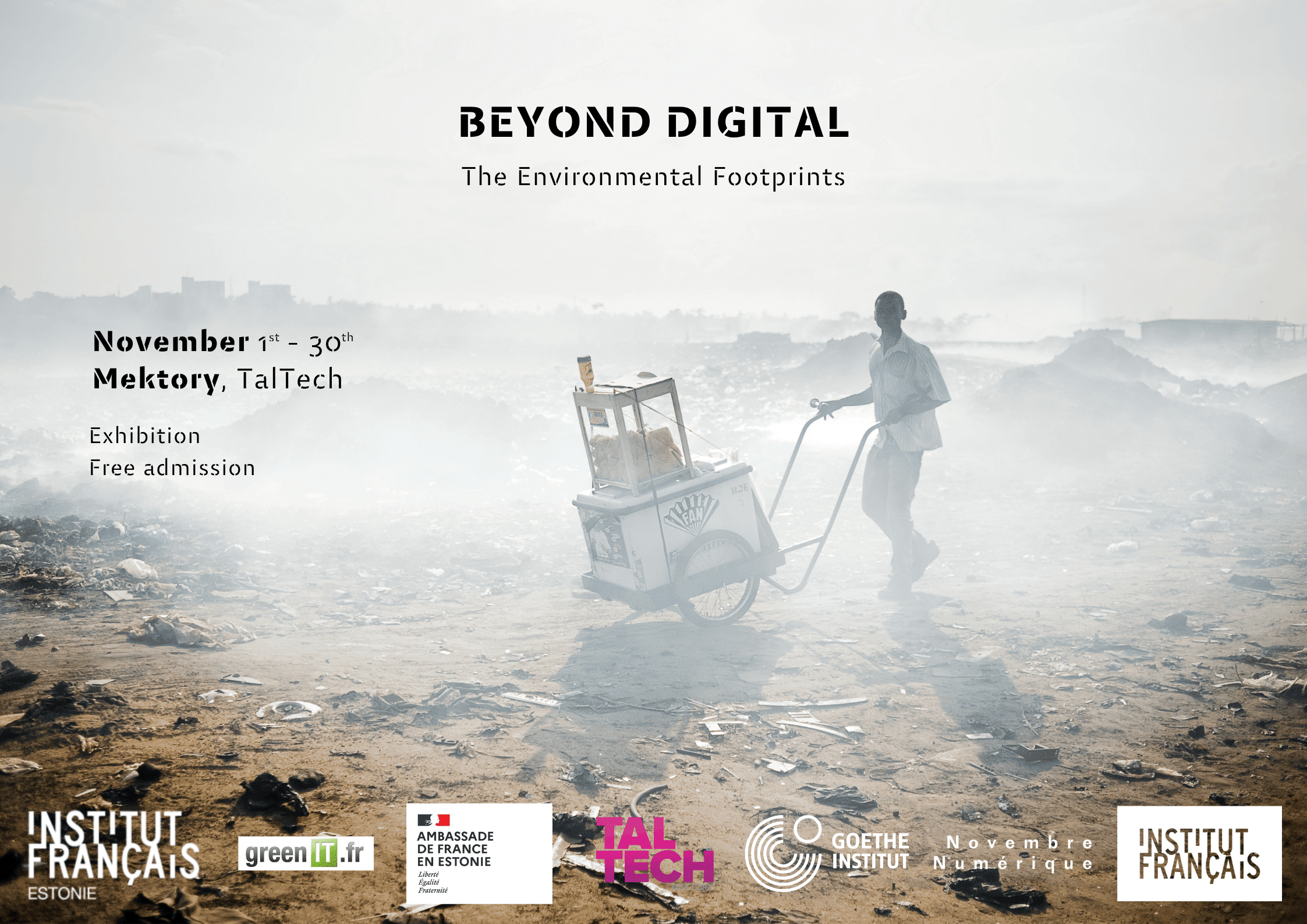
As part of the Digital November 2021 edition, the French Institute of Estonia presents the exhibition “Beyond Digital. The Environmental Footprints”, which aims to tackle the links between digital and ecology, and the environmental consequences of digital technologies. An educational, multimedia and artistic exhibition, to be freely seen at the Mektory Center, from 1 to 30 November 2021.
About the exhibition | “Beyond Digital”
This exhibition invites you to take a journey through the environmental impacts of digital technology. It traces the life cycle of a smartphone and the ecological impact caused at each stage of this journey. Of course, it is not all doom and gloom and solutions exist. This is why this exhibition is designed with a practical solutions corner, to raise awareness of these issues so that we can all reflect, at our level, on our digital practices, and act accordingly. The aim is to make digital technology more sustainable: for the planet, for the future.
The exhibition consists of a series of educational panels aimed at understanding, step by step, all the environmental consequences of digital technology. A journey around the world, which highlights industrial practices that are not very virtuous, and sometimes scandalous: child labour, civil conflicts, systematic pollution (of the air, water, soil) and the destruction of ecosystems.
These explanations are accompanied by a range of resources, indicated by QR codes, to extend certain aspects of these issues through videos, articles and multimedia resources.
Finally, the exhibition is built around three photographic series by the artist Kai Löffelbein, from his work “CTRL-X: a topography of electronic waste“. A journey to Ghana, India and China, which visually provide tangible proof, if any were needed, of these environmental consequences of the digital development of our societies.
Acknowledgements / contributors
This exhibition was conceived and prepared by the French Institute of Estonia, which produced the artistic design and the various contents, under the scientific supervision of the Green IT collective in France. It was supported by several partners: the French Embassy in Estonia; the Goethe Institute; TalTech. The graphic design of the panels was created by Emeric Weber.
Abstract
We think of digital as ‘virtual’. We say that our data is stored “in the cloud”: we have become accustomed to carrying our smartphone with us everywhere, connecting us to every point on the planet and at any time of the day or night, transmitting data immaterially.
But behind our screens, in reality, lie mountains of resources: a history of metals, which must be extracted in large quantities, then assembled, transformed and distributed, before these objects and their contents are consumed, then thrown away or forgotten. Producing a smartphone also means using water at each stage of manufacture, contaminating it and discharging it into the ground and water tables, contaminated with heavy metals, which are then discharged into rivers that have sometimes become radioactive. Electricity is also needed, for example, to run data centres, but also to keep the undersea cables and antennas that connect our routers and wifi terminals running without interruption.
So, in the face of ever-increasing digital usage, how long can the earth withstand the appetite for digital resources?