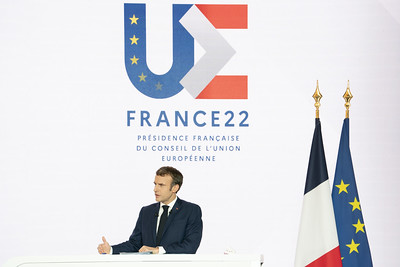
For the first time in 14 years, France will take over the Presidency of the Council of the European Union (EU) on January 1, 2022. How does the EU Council Presidency work and what will France’s role be in it?
Find all the information on the French Presidency of the Council of the European Union on the official website of the Presidency.
What is the Presidency of the Council of the European Union?
A rotating presidency
Each Member State rotates the Presidency of the Council of the European Union for six months. From 1 January to 30 June 2022, France will hold the Presidency of the Council of the EU. The Council Presidency organizes meetings, works out compromises, delivers conclusions and ensures the coherence and continuity of the decision-making process. It ensures good cooperation between all Member States and manages the Council’s relations with the European institutions, in particular the Commission and the European Parliament.
What is the Council of the European Union?
The Council of the European Union, also known as the “Council of Ministers of the European Union” or “Council”, brings together the ministers of the EU Member States by field of activity. Together with the European Parliament, it is the co-legislator of the European Union.
In concrete terms, the ministers will preside over ten areas of activity or formations of the Council of the EU: general affairs; economic and financial affairs; justice and home affairs; employment, social policy, health and consumer affairs; competitiveness (internal market, industry, research and space); transport, telecommunications and energy; agriculture and fisheries; environment; education, youth, culture and sport; and trade. By exception, the Foreign Affairs Council is chaired by the High Representative of the Union for Foreign Affairs and Security Policy, currently Josep Borrell.
The Council also has budgetary powers: it adopts and modifies the European budget with the Parliament. Finally, the Council adopts certain decisions and non-binding recommendations, concludes the Union’s international agreements and appoints the members of certain institutions (Court of Auditors, European Economic and Social Committee, Committee of the Regions). The Council’s deliberations and votes on legislative acts are public.
What is the framework for the French Presidency of the Council of the European Union (FPEU)?
The FPEU is in line with the orientations set by the President of the Republic in his speech for a sovereign, united and democratic Europe delivered on September 26, 2017 at the Sorbonne. For four years, the President of the Republic and the Government have been working to build real European sovereignty, that is, Europe’s ability to exist in today’s world to defend our values and interests. The French Presidency of the Council of the European Union will continue this work for a more united, more sovereign and more democratic Europe.
The FPEU responds to the expectations of citizens, who expressed them during the citizens’ debates organized in September in the 18 French regions as part of the Conference on the Future of Europe. This project, proposed by France in 2019, has opened a new space for debate with European citizens. The final contribution of these citizens’ panels was submitted to the Government in the fall. The recommendations made by citizens, in France and in Europe, feed the priorities of the French Presidency of the Council of the European Union.
The FPEU is linked to the program of the “trio” of presidencies, in which France is involved. This system, which has been in place since 2009, makes it possible to set long-term objectives and define the major issues that will be addressed over an 18-month period. After the Slovenian Presidency, France will begin a new cycle and will work in trio with the Czech Republic in the second half of 2022 and Sweden in the first half of 2023.
Nearly 400 events
In total, nearly 400 events planned in France and within the EU will punctuate the Presidency: political meetings, a cultural program and citizen events open to all.
In addition, in order to ensure that the French presidency is well known to the public, events will be held throughout France and abroad.
The Council of the EU should not be confused with:
- the European Council, which brings together the heads of state and government of the member states and defines the general political guidelines and priorities of the European Union. Its current president is Charles Michel.
- the Council of Europe, which is an intergovernmental organization made up of 47 member states. Created in 1949, its mission is to promote the development of human rights, democracy and the rule of law. Its headquarters are in Strasbourg and its Secretary General is Marija Pejčinović Burić.
More information:
- ENG: European Council
- EST: Euroopa Ülemkogu